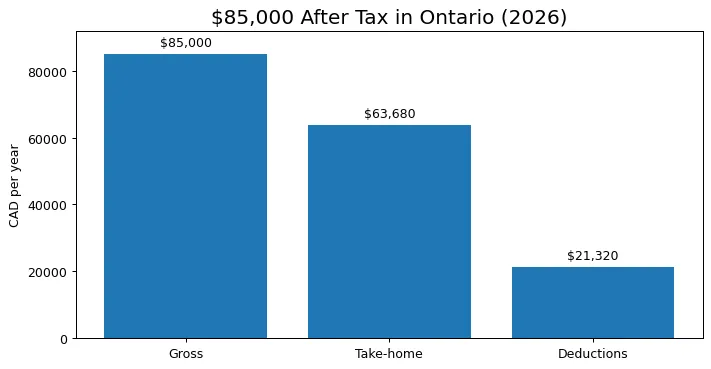
$85,000 after tax in Ontario in 2026 is estimated at about $63,680 per year after federal and Ontario income tax, CPP, CPP2 and EI for a standard employee with no major additional deductions. That works out to roughly $5,307 per month, $2,449 every two weeks, or $1,225 per week.
This guide explains the 85000 after tax Ontario calculation using 2026 federal and Ontario tax brackets, CPP contribution limits, CPP2 and Employment Insurance rates. The figures are estimates for planning purposes, not a personalized tax return calculation. RRSP contributions, employer benefits, pension deductions, bonuses, tax credits and other income can all change the final result.
Quick Answer: $85,000 After Tax in Ontario in 2026
| Item | Estimated 2026 Amount |
|---|---|
| Gross annual salary | $85,000 |
| Estimated federal income tax | $10,227 |
| Estimated Ontario income tax and health premium | $5,324 |
| Total estimated income tax | $15,551 |
| CPP base + first additional CPP | $4,230.45 |
| CPP2 | $416.00 |
| Employment Insurance (EI) | $1,123.07 |
| Estimated annual take-home pay | $63,680 |
| Estimated monthly take-home pay | $5,307 |
| Estimated biweekly take-home pay | $2,449 |
| Estimated weekly take-home pay | $1,225 |
Assumptions: Ontario resident, employment income only, standard federal and Ontario basic personal amounts, standard Canada employment amount, no RRSP deduction, no pension adjustment, no taxable benefits, no other income and no special credits. Payroll withholding may differ slightly from the annual estimate.
How Much Is $85,000 After Tax in Ontario?
On an $85,000 salary, the estimated total of federal income tax, Ontario income tax, Ontario health premium, CPP contributions and EI premiums is about $21,320. Subtracting those statutory deductions leaves estimated net income of approximately $63,680.
The important point is that Canada uses a progressive income tax system. You do not pay one tax rate on the entire $85,000. Different portions of your taxable income are taxed at different federal and provincial rates. Non-refundable credits then reduce the calculated tax, while CPP and EI are separate payroll deductions.
If you want advice based on your own deductions, credits, side income or investments, see our personal tax accountant services in Toronto.
2026 Federal Tax Brackets on an $85,000 Salary
For 2026, the federal tax rate is 14% on the first $58,523 of taxable income and 20.5% on the next portion up to $117,045. An $85,000 salary therefore falls partly into the 14% bracket and partly into the 20.5% bracket.
| 2026 Federal Taxable Income | Federal Rate |
|---|---|
| $0 to $58,523 | 14% |
| $58,523.01 to $117,045 | 20.5% |
| $117,045.01 to $181,440 | 26% |
| $181,440.01 to $258,482 | 29% |
| Over $258,482 | 33% |
The estimate on this page also accounts for common federal non-refundable credits, including the basic personal amount, the Canada employment amount, the creditable base CPP contribution and EI premiums. Enhanced CPP contributions are treated differently from the base CPP amount and can affect taxable income.
2026 Ontario Tax Brackets
Ontario tax is calculated separately from federal tax. For 2026, the first $53,891 of Ontario taxable income is taxed at 5.05%, while the next portion up to $107,785 is taxed at 9.15%. Since $85,000 is below the third Ontario threshold, the 11.16% provincial bracket does not apply to this salary level.
| 2026 Ontario Taxable Income | Ontario Rate |
|---|---|
| $0 to $53,891 | 5.05% |
| $53,891.01 to $107,785 | 9.15% |
| $107,785.01 to $150,000 | 11.16% |
| $150,000.01 to $220,000 | 12.16% |
| Over $220,000 | 13.16% |
Ontario also charges the Ontario Health Premium. At this income level, the annual premium reaches the applicable $750 maximum for the $72,000 to $200,000 income range. The final Ontario amount is reduced by eligible provincial tax credits before the health premium is added.
CPP and EI Deductions on $85,000 in 2026
Income tax is only part of the difference between gross salary and take-home pay. Employees also contribute to the Canada Pension Plan and Employment Insurance.
CPP Contributions
For 2026, the Year’s Maximum Pensionable Earnings (YMPE) is $74,600 and the Year’s Additional Maximum Pensionable Earnings (YAMPE) is $85,000. The maximum employee contribution for CPP base plus the first additional component is $4,230.45. Because an $85,000 salary reaches the 2026 YAMPE, the maximum CPP2 employee contribution is another $416.
Employment Insurance
For workers outside Quebec, the 2026 EI premium rate is $1.63 per $100 of insurable earnings. The maximum insurable earnings are $68,900, producing a maximum annual employee EI premium of $1,123.07. Someone earning $85,000 for the full year would normally reach that annual maximum.
$85,000 a Year Is How Much a Month After Taxes?
Based on the assumptions used here, estimated annual take-home pay of $63,680 converts to approximately:
- Monthly: $5,307
- Semi-monthly (24 pay periods): $2,653
- Biweekly (26 pay periods): $2,449
- Weekly: $1,225
Your actual paycheque can be different because employers calculate payroll deductions by pay period. Bonuses, commissions, taxable benefits, group insurance, workplace pensions and extra tax requested on Form TD1 can all change a particular paycheque.
What Is the Marginal Tax Rate on $85,000 in Ontario?
At approximately $85,000 of taxable income, the combined federal and Ontario marginal income tax rate is generally 29.65%: 20.5% federal plus 9.15% Ontario. That does not mean 29.65% of the full $85,000 salary is paid in income tax. The lower portions of income are taxed at lower rates, and tax credits reduce the final tax bill.
Using the assumptions in this guide, estimated income tax is about $15,551, which is roughly 18.3% of gross salary. When CPP and EI are included, total statutory deductions are roughly 25.1% of gross salary. This distinction between marginal rate, average income-tax rate and total payroll deductions is important when budgeting.
What Can Change Your $85,000 Take-Home Pay?
The estimate above is a baseline. Your actual net pay can move higher or lower depending on your circumstances. Common factors include:
- RRSP contributions: deductible contributions can reduce taxable income.
- Workplace pension contributions: these can reduce current cash pay and may affect taxable income.
- Bonuses and commissions: withholding on individual bonus payments can look higher even though final annual tax is based on total income.
- Taxable benefits: employer-paid benefits may increase taxable employment income.
- Other income: self-employment, rental, investment or foreign income can increase total tax payable.
- Tax credits: eligible medical, disability, tuition, spouse or other credits may reduce final tax.
- RRSP, FHSA and other deductions: eligibility and deductibility depend on your specific situation.
For year-round planning, our tax planning services can help identify which deductions and timing strategies may apply to your circumstances.
Compare $85,000 After Tax With Nearby Ontario Salaries
If you are comparing job offers or salary increases, these nearby salary guides may also help:
A salary increase does not cause your entire income to be taxed at the higher bracket. Only the portion that falls into the next bracket is taxed at the higher marginal rate.
Is $85,000 a Good Salary in Ontario in 2026?
Whether $85,000 is a good salary depends much more on household size, housing costs, debt, childcare, transportation and location than on the tax calculation alone. A single person renting outside the most expensive neighbourhoods may have very different disposable income from a household supporting children or carrying a large mortgage.
For budgeting, the more useful number is not the $85,000 gross salary but the estimated $5,300 monthly take-home pay before optional deductions and personal expenses. From there, subtract housing, transportation, debt payments, food, insurance, savings and other recurring costs to judge affordability for your own situation.
Frequently Asked Questions
How much is 85000 after tax Ontario in 2026?
Under the standard assumptions used in this guide, $85,000 after tax in Ontario is approximately $63,680 per year after estimated federal and Ontario income tax, CPP, CPP2 and EI. Actual results can differ based on credits and deductions.
How much is $85,000 a year biweekly after taxes in Ontario?
Estimated take-home pay is about $2,449 every two weeks when annual net pay is divided across 26 pay periods. Your employer’s actual payroll calculation may vary slightly.
How much is $85,000 a year per month after tax?
The estimated monthly take-home pay is approximately $5,307, based on annual net pay divided by 12 months.
What tax bracket is $85,000 in Ontario?
At this income level, the top portion is generally in the 20.5% federal bracket and the 9.15% Ontario bracket, for a combined marginal income-tax rate of about 29.65%. Lower portions of income are taxed at lower rates.
Does an $85,000 salary pay the maximum CPP and EI in 2026?
At $85,000 of annual employment income, an employee can reach the 2026 maximum for CPP base plus first additional CPP, the maximum CPP2 contribution, and the maximum EI premium, assuming they are subject to contributions for the full year.
2026 Sources and Calculation Notes
This estimate uses 2026 information published by the Government of Canada and the Canada Revenue Agency. For current official figures, see the CRA’s 2026 income tax rates and brackets, the CRA’s 2026 Ontario payroll deduction tables, the Government of Canada’s CPP contribution information, and the 2026 EI premium information.
Important: This article provides a general estimate, not personal tax advice. If you need a calculation based on your own deductions, credits, investments or other income, contact Filing Taxes for assistance.